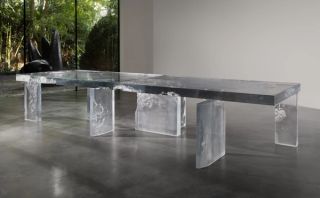
Anne Holtrop Low-relief
London

Anne Holtrop (b. 1977, the Netherlands) is an architect whose work explores the relationship between matter and space under the influence of environmental conditions — climate, geology, light, and time. He founded Studio Anne Holtrop in 2009 in Amsterdam and has led it from Muharraq, Bahrain, since 2014.
Matter, in Holtrop’s work, is explored through intervening in its different states — an approach he calls “material gesture”. This spans the states matter passes through, from its origin in sourcing and the processing of raw material, through casting, to its continuous change over time. His interest lies in the way a material can record environmental conditions as a spatial condition.
At the Siyadi Pearl Museum, the silver-leaf-lined main room is named the
“oxidation room,” a surface registering the saline air and humidity that darkens over time. At the Misk Art Institute in Riyadh, structural cast glass panels, the first of their kind in size — made through a groundbreaking process developed over five years — absorb heat and diffuse the desert light, making the weather conditions the building’s material. Forming the limit of a space, such materials keep the space in constant relation to a changing environment.
His spatial-material approach is applied to a variety of scales, from architecture, to interiors and furniture. Notable projects include Museum Fort Vechten in the Netherlands, Customs House and Green Corner Building in Bahrain, retail stores worldwide for Maison Margiela and Charlotte Chesnais, and a debut series of glass furniture pieces for Carpenters.
Holtrop received the Aga Khan Award for Architecture (2020), the Iakov Chernikhov International Prize (2016), and the Charlotte Köhler Prize for Architecture by the Prince Bernhard Cultural Foundation (2007). Monographs on his work have been published by 2G, El Croquis, and AV Monografías. He is a professor at the Accademia di Architettura di Mendrisio, and has taught at ETH Zürich and the Sandberg Instituut, Amsterdam.
Exhibitions